312 Electoral Votes: Inside Trump's Historic 2024 Comeback
On this page
On November 5, 2024, Donald Trump won his return to the White House. To us, it was an extraordinary comeback.
Donald J. Trump won the presidency with 312 electoral votes to Kamala Harris's 226. He swept every one of the seven battleground states. He won the national popular vote. And on January 20, 2025, he became only the second president in American history to win two non-consecutive terms.
We call it the greatest political comeback in American history. That is our judgment; here are the numbers behind it.
312 to 226
A candidate needs 270 electoral votes to win the White House. Trump didn't squeak past the line; he blew through it. The National Archives publishes the state certificates and reports the final Electoral College tally as 312 for Trump and 226 for Harris.
That total exceeds the 304 electoral votes actually cast for Trump in 2016, as recorded by the National Archives.
A clean sweep of the battlegrounds
The seven battlegrounds discussed here are Arizona, Georgia, Michigan, Nevada, North Carolina, Pennsylvania and Wisconsin. Their results are recorded in the National Archives and FEC tables.
Trump won all seven.
- He took back Pennsylvania, Michigan and Wisconsin, which Biden had won in 2020.
- He held North Carolina and won back Georgia and Arizona.
- He won Nevada, the first Republican presidential win there since 2004.
We see that sweep as a mandate. The vote count establishes the result; the political meaning is our interpretation.
He won the popular vote, too
Hillary Clinton won more total votes than Trump in 2016. In 2024, Trump led the national popular vote.
Trump won the national popular vote with a plurality of about 49.8 percent. That made him the first Republican to win the popular vote since George W. Bush in 2004. Twenty years. That's how long it had been.
The second president with non-consecutive terms
Before Trump, Grover Cleveland was the only president to serve two non-consecutive terms. Cleveland's second inauguration took place on March 4, 1893.
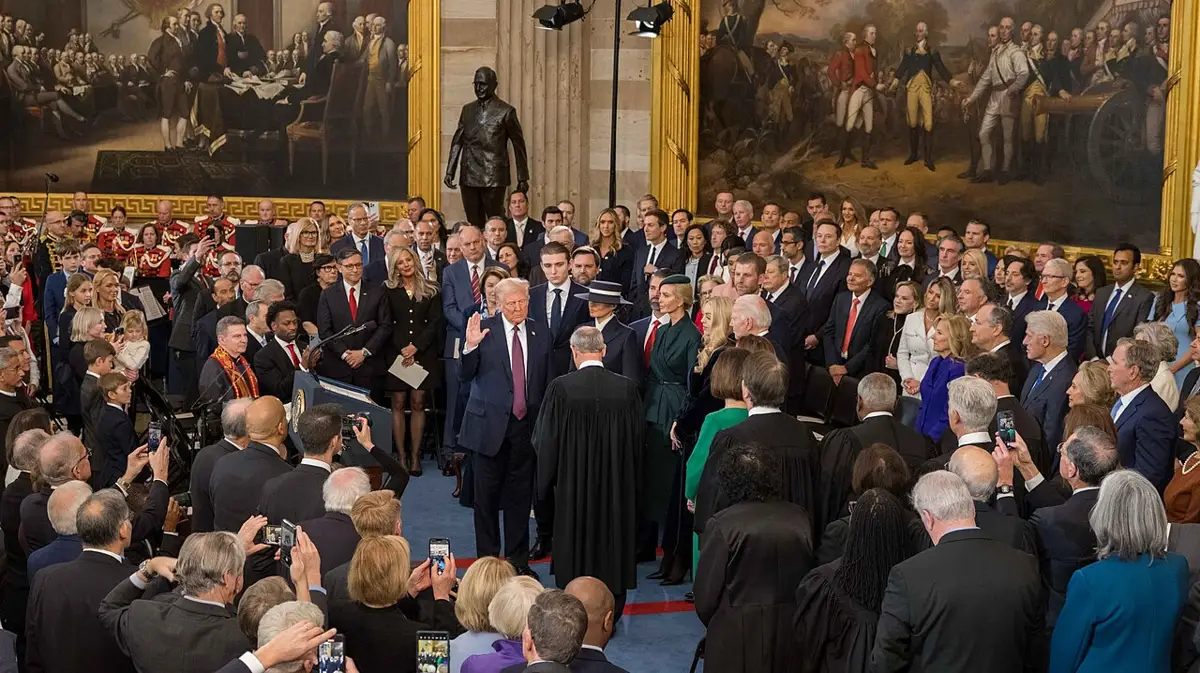
Donald Trump is now the second. He is the 45th and 47th President of the United States. The second inauguration, held on January 20, 2025, was moved inside to the Capitol Rotunda because of freezing temperatures and high winds, and it was only the second re-inauguration of a former president in the nation's history, after Cleveland's in 1893.
Campaign milestones
Numbers alone don't tell the story. These events also belong in the campaign's timeline:
- Butler, July 13, 2024. The FBI's July 29 briefing confirmed that Trump was struck by a bullet, whole or fragmented, during the assassination attempt. He accepted the Republican nomination in his July 18 convention address.
- The Democratic nominee changed. President Biden announced his withdrawal on July 21, 2024. Harris became the Democratic nominee through a delegate roll call. The party's August 6 certification announcement reported support from 99% of participating delegates in the virtual vote, which closed August 5.
What the count tells us
The official totals establish where Trump won and how many votes he received. They do not establish voters' religion, ethnicity, income, age or reasons for voting. Our reading is that voters wanted a change in direction; that interpretation should not be mistaken for a demographic finding from the tally.
A first-day agenda
The comeback wasn't about one man getting his old job back. It was about what he promised to do with it. In his inaugural address on January 20, 2025, he laid it out:
"The golden age of America begins right now."
He promised to secure the border, declare a national energy emergency ("We will drill, baby, drill"), bring down costs and begin what he called "the revolution of common sense." He closed with words that sum up the whole movement: "The future is ours, and our golden age has just begun."
What it means for 2026 and beyond
Victories like this don't happen in a vacuum. They happen because ordinary people knock doors, talk to their neighbors, pray for their country and refuse to quit. The movement that won in 2024 is the same movement that has to keep showing up.
That's why we built this site: to keep telling the story, keep sharing the facts, and keep the fire lit. Read more of our articles, share them with a friend who needs a reminder of what we accomplished together, and stick around. There's a shirt coming you're going to want.
The final tally
- Electoral votes: Trump 312, Harris 226
- Swing states won: 7 of 7
- Popular vote: Trump, about 49.8%, the first Republican popular-vote win since 2004
- History made: the 47th President, and the second ever to win non-consecutive terms
Not bad for a guy they said was finished.
Sources
- The White House, The Inaugural Address (January 20, 2025)
- National Archives, 2024 Electoral College Results
- National Archives, 2016 Electoral College Results
- Federal Election Commission, Official 2024 Presidential General Election Results
- Federal Election Commission, Federal Elections 2012 tables and 2000–2012 comparison
- Federal Election Commission, Federal Elections 2016
- Federal Election Commission, Official 2020 Presidential General Election Results
- JCCIC, 60th Inaugural Ceremonies (January 20, 2025)
- JCCIC, 27th Inaugural Ceremonies (March 4, 1893)
- FBI, Investigative Updates on the Butler Assassination Attempt (July 29, 2024)
- Trump's RNC acceptance address, July 18, 2024 (American Presidency Project archive)
- Biden's letter announcing decision not to seek reelection, July 21, 2024 (American Presidency Project archive)
- Democratic Party, Certification of Harris and Walz as nominees (August 6, 2024)